

Pride: Victor Cazalet & the Glamour Boys

To celebrate Chippenham Pride 2023 we’re sharing some of the inspirational stories of influential LGBTQIA+ figures from our latest exhibition ‘Chippenham Between the Wars’, exploring life in the town in the 1920s and 30s.
Our first blog focuses on Chippenham MP Victor Cazalet. Cazalet was born into a wealthy family of Huguenot descent. The family had a country home in Kent, which was coincidently the former home of another Chippenham MP Robert Peel. They also owned a villa in the south of France where Queen Victoria was a regular guest, and she became Victor’s godmother.

Mrs. Cazalet and Children, Edward and Victor (seated), by John Singer Sargent, 1900-01. The painting is currently owned by another queer icon Barbra Streisand, who has gifted it to the Los Angeles County Museum of Art.
Cazalet himself was godfather to the actress Elizabeth Taylor, whose family would spend weekends on his own estate in Kent. For her fifth birthday Cazalet gifted her a pony, and she spent her early years riding across the grounds of his home. Cazalet played an instrumental role in kickstarting Taylor’s acting career. He put the family in touch with his friend Hedda Hopper, the famous Hollywood gossip columnist, whose influence could make or break careers, thankfully she agreed to help. Elizabeth Taylor is regarded by many as a queer icon for her activism during the Aids crisis of the 1980s and 90s.
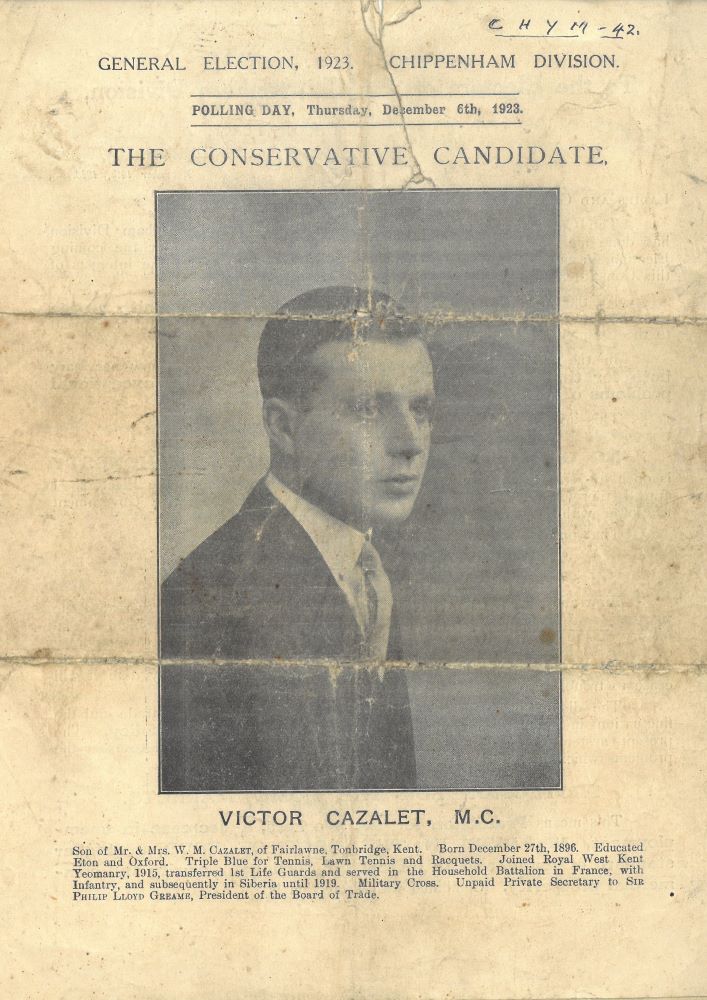
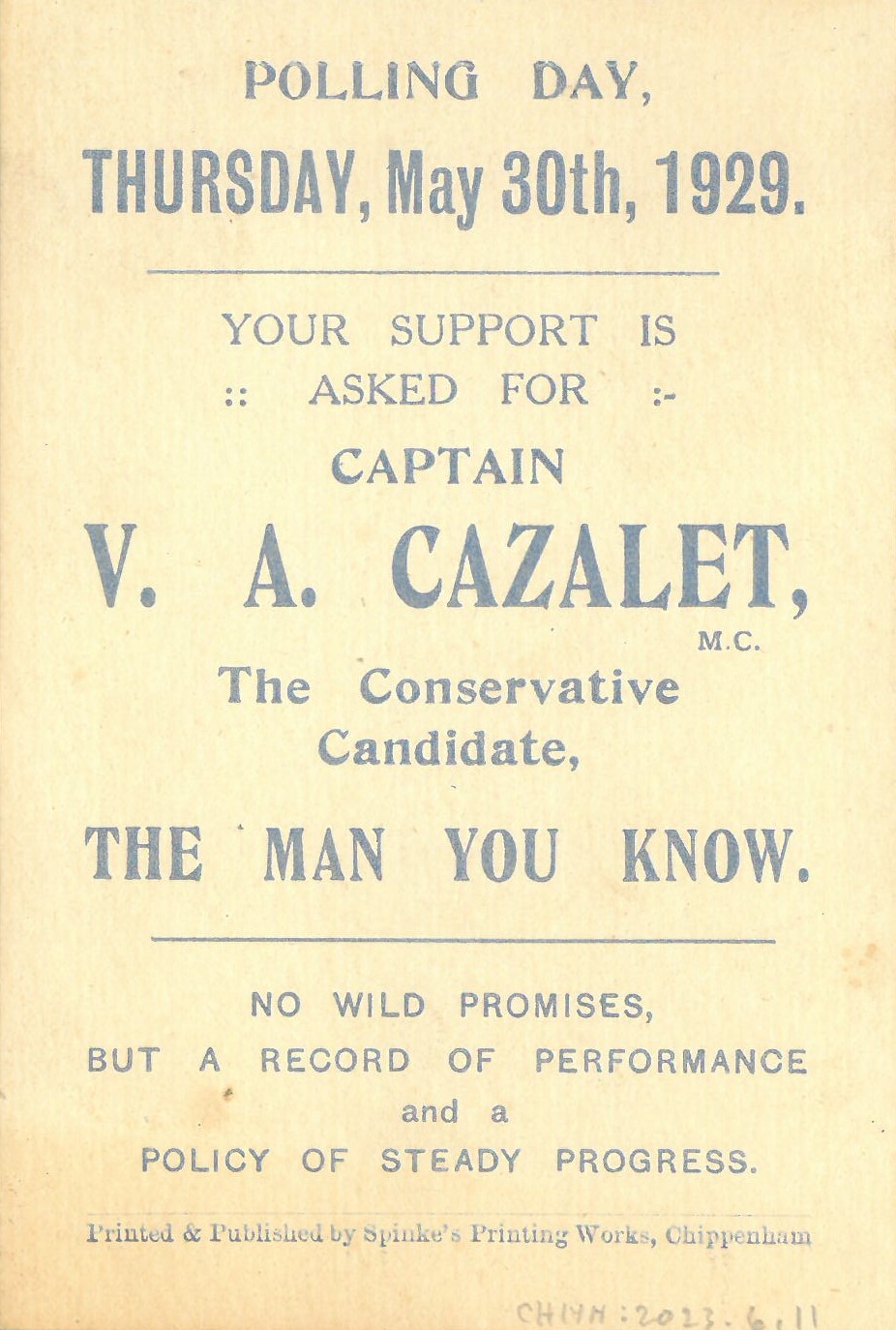
Victor Cazalet campaign material, 1923 & 1929, Chippenham Museum
Cazalet served during the First World War, and was awarded the military cross for gallantry. He became conservative MP for Chippenham in 1924, holding the seat until his untimely death in 1943. He regularly spoke out in parliament on a number of issues. He campaigned that married women should be able to keep their own nationality rather than take on that of their husband. He also proposed an import ban on important artworks to prevent them being sold abroad, a system that is in place today. At the height of the Depression he shocked the Commons by suggesting MPs lead by example and take a pay cut. At a time when Britain remained largely antisemitic, Cazalet spoke out against the persecution faced by Jewish people and supported the creation of a Jewish homeland.
Although it is problematic applying contemporary terms to the past, Cazalet was bisexual or gay and frequently had to defend his status as an unmarried ‘Bachelor MP’. He was part of a wider gay artistic circle that included Somerset Maugham, Noel Coward and Cole Porter. Like many gay men he made frequent visits to Berlin and its flourishing queer counter culture, where he also witnessed the emergence of the Nazi party.

Victor Cazalet, signed campaign material, 1935, Chippenham Museum
Like many, Cazalet was initially indifferent to events happening in Germany under Hitler and the Nazis. This would soon change. Cazalet was good friends with the famous German tennis star Gottfried von Cramm, who was in a relationship with the Jewish actor Manasse Herbst. As both Jewish and gay it became clear that Herbst was in danger and Cazalet helped facilitate his escape from Germany. Later on, he was unable to intervene when Cramm was imprisoned for ‘sex perversion’.
With first-hand experience of the atrocities being carried out by the Nazis, Cazalet was part of a group of MPs that began to speak out. Not all of the group were gay or bisexual, but a significant number were, and they became labelled the ‘Glamour Boys’, a derogatory insinuation on their sexuality. The group spoke out against appeasement, voted against the government and called for rearmament. By being part of the group they drew attention to themselves, risking exposure and imprisonment at time when homosexuality was illegal. Author and Labour MP Chris Bryant, believes that without the intervention of the group, Britain ‘would never have gone to war with Hitler, Churchill would never have become prime minister and Nazism would never have been defeated’.
To find out more about Victor Cazalet and the Glamour Boys look out for the book ‘The Glamour Boys: The Secret Story of the Rebels who Fought for Britain to Defeat Hitler’ by Chris Bryant.


Chippenham Town Council
(opens in a new tab)Official Chippenham Town Council Facebook
Monitored: Mon-Thu: 9am - 5pm, Fri 9am - 4:30pm

We are pleased to share that Chippenham has successfully achieved Purple Flag re-accreditation for the tenth consecutive year.
Awarded by the Association of Town and City Management, Purple Flag is an internationally recognised accreditation that celebrates town and city centres offering a safe, vibrant and diverse evening and night-time economy between 5pm and 5am.
This achievement reflects our commitment to working collaboratively with partners to create a dynamic, safe, and vibrant evening and night-time economy. Assessors highlighted our effective multi-agency working, and recognised Chippenham as an attractive destination that makes excellent use of its heritage assets with ambitious plans for the future development of the riverside.
With fewer than 100 Purple Flag destinations worldwide, we are proud that Chippenham continues to be recognised as a place where people can enjoy a high-quality, safe and thriving evening experience.
For more information, please visit bit.ly/PurpleFlag_10
Trees and hedges are among the most reported issues in Chippenham. We are lucky to have an Arboricultural Officer in the Environmental Services Team who cares for our urban forest.
To find out how this is cared for, how we maintain hedges and shrubs, and how to report any concerns, please visit this link - bit.ly/Tree_care