

Pride: Design Duo Barron and Larcher

In this second blog to celebrate Chippenham Pride 2023, we’re looking at an interwar LGBTQIA+ design duo, whose work features in our latest exhibition ‘Chippenham Between the Wars’.
The decades between the wars saw the emergence of a number of prominent queer women working in the world of craft and design, who were part of what has been called a “creative lesbian sub-culture” of the wider arts and craft movement. Alongside the likes of lesbian and bisexual artists such as Enid Marx and Katherine Pleydell-Boverie, was the partnership of Phyllis Barron and Dorothy Larcher.

Phyllis Barron, 1930s. Tanner Archive, Crafts Study Centre

Dorothy Larcher, 1930s. Tanner Archive, Crafts Study Centre
Barron and Larcher were two of the leading textile designers and printers in Britain during the 1920s and 30s. Their relationship was described as a ‘marriage of true minds’. As well as love and companionship, their relationship also provided mutual creative support, at a time when the art world remained dominated by men.
The response to lesbian relationships between the wars was mixed. While homosexual acts between men had long been a punishable offence, this had not been the case for women. In 1921 attempts were made to introduce a crime of ‘gross indecency between females’ but was viewed as unnecessary because it was still inconceivable that women could have sexual desires, whether towards men or women! The deaths of so many men during the First World War, had led to what were known as ‘surplus’ women. Women living and socialising together without men, became a common sight. This in turn provided an opportunity for those in lesbian relationships to live more openly and visibly.
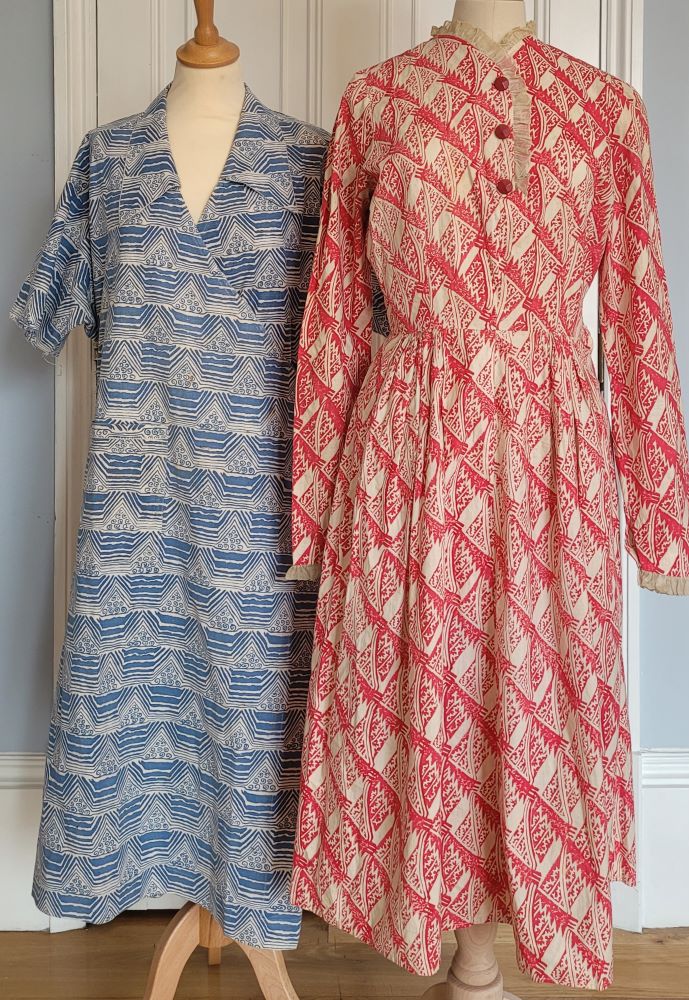
Left: Overall/Wrap-dress, c.1935, in blue Onde pattern, Right: Dress, c.1935 in red Vernede pattern, both dresses on loan from Persephone Book, who have used these patterns for endpapers on recent publications of As It Was by Helen Thomas and A Well Full of Leaves by Elizabeth Myers
Barron and Larcher first set up home in London, before moving to Painswick in the Cotswolds in 1930. They established and ran their own studio, laboriously and painstakingly hand printing their own textiles. They received many commissions, including textiles for the Girton college, the first women’s college in the University of Cambridge. They were even introduced to Gabrielle ‘Coco’ Chanel, about whom Barron wrote:
“I think she thought I was a very queer sort of person – she couldn’t understand why I should want to do this strange thing. I was dressed as usual entirely in my own stuff, all made by myself, and I don’t think that she had ever in her life seen so much hand sewing, which she really quite appreciated. She thought the whole affair rather amusing, and ordered cushions for her Paris garden”
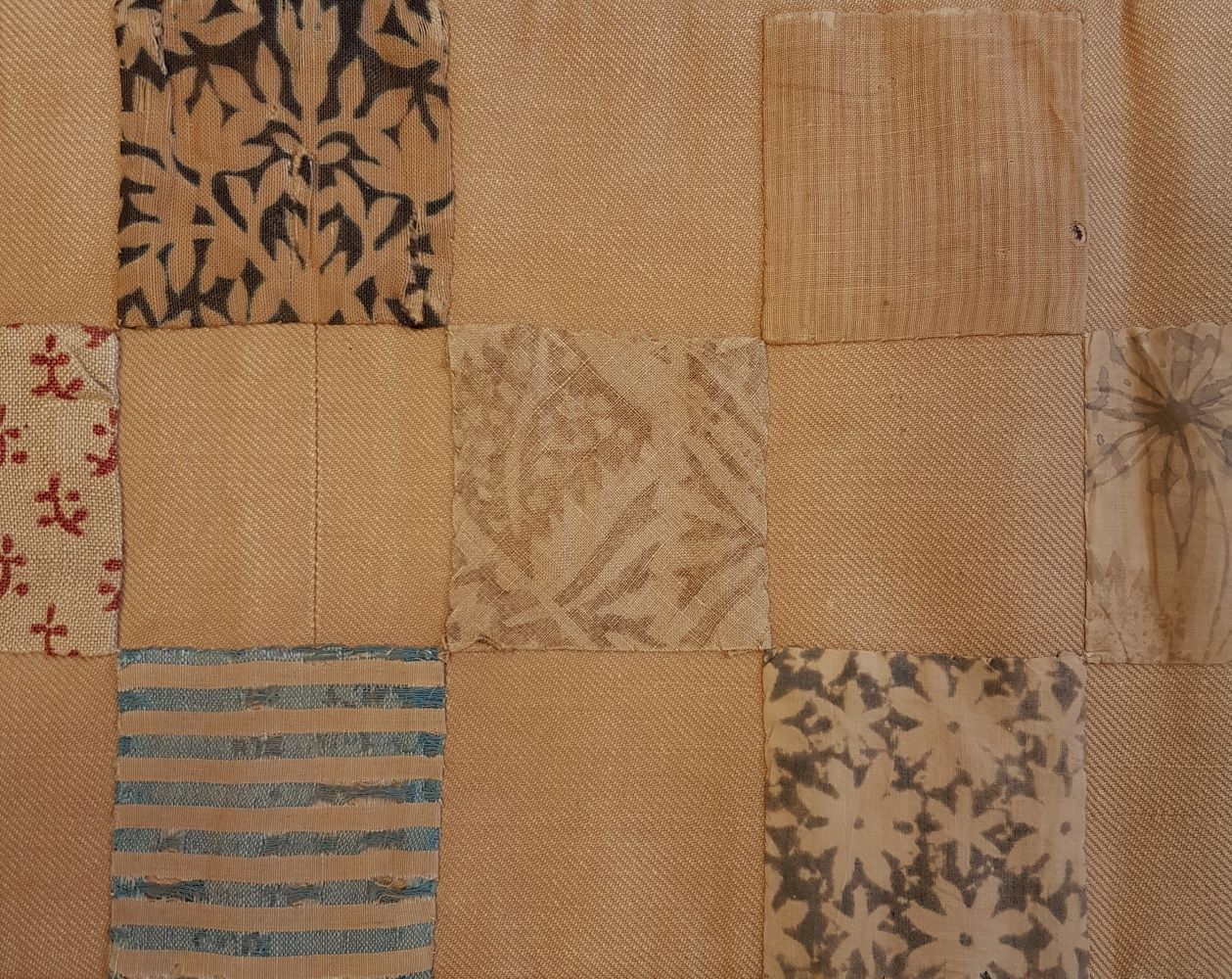
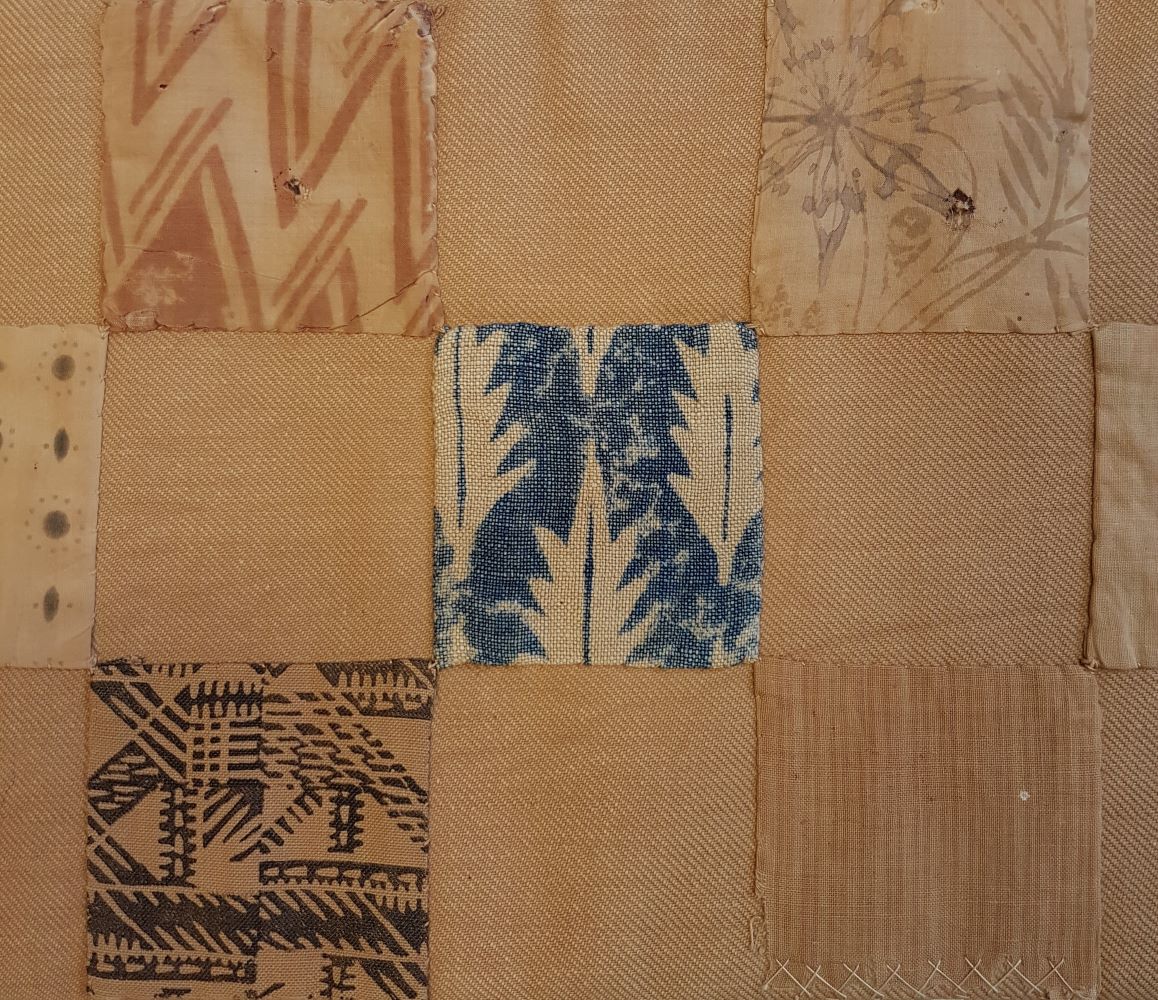
Details of pelmet, from the home of Robin and Heather Tanner, made from offcuts of textiles handprinted by Barron and Larcher, Chippenham Museum
Barron’s designs tended to have strong geometric forms, while Larcher preferred plants and flowers. These designs would be cut into wooden or lino blocks for printing. The pair experimented with the placement of blocks, using the same block at different angles, combining two blocks on the same textile, as well as overprinting one block on top of another. They also printed from ‘found’ objects, including car mats and pastry cutters.
In 1931 local artists and writers Robin and Heather Tanner moved to Kington Langley. They went to Barron and Larcher for textiles for their new home. The four became firm friends, visiting and holidaying together. After Dorothy’s death in 1952, Phyllis and Robin began the mammoth task of cataloguing the Barron and Larcher archive. On Phyllis’ death in 1964 she left the archive to Robin who completed the catalogue, including handwritten descriptions on every page. He gifted it as part of the founding collection of the Craft Study Centre, now part of the University for the Creative Arts.
To find out more about Phyllis Barron and Dorothy Larcher, visit the Craft Study Centre’s online exhibition here


Chippenham Town Council
(opens in a new tab)Official Chippenham Town Council Facebook
Monitored: Mon-Thu: 9am - 5pm, Fri 9am - 4:30pm
Due to the yellow weather warning by the Met Office, and to ensure the comfort and safety of all traders and shoppers, the decision has been made to cancel the market on Friday 23 October.
At present, Saturday’s market will go ahead as planned. We will continue to monitor the forecasted weather and update you again if this changes.

We really do not want people to be choosing their pumpkins in the wind and rain, due to the yellow weather warning issued by the Met Office. To ensure this event can be enjoyed as much as possible, we have made the decision to reschedule the Pumpkin Patch event until Tuesday 27 October at 10am.
If you were hoping to meet the Beauty and the Beast Pantomime Cast, you can still see them in the High Street between 10am - 11am, REEL Cinema Chippenham 11pm - 12pm, Chippenham Library 1pm - 2pm and Chippenham Museum 2pm - 3pm.
The footpath that runs adjacent to John Coles Park, between King Alfred Street and Hungerford Road, remains closed allow essential wall repairs to take place.
Wiltshire Council have advised the works are currently expected to be completed by 31 October 2026, although the closure may be extended if necessary.
A signed diversion route is in place via King Alfred Street, Hardenhuish Avenue, Marshfield Road, Park Terrace and Park Fields.
For further information about the closure or the works, please contact Wiltshire Council on 0300 456 0100 or visit one.network/public