

Art in Exile: The Work of Charles Wellens – Part Two

In this second blog on Charles Wellens, we look at the painting itself. It was produced by Wellens in 1915 when he lived in Chippenham. It shows Common Slip and is painted in a style inspired by the work of Impressionists such as Monet and Renoir.

The painting was previously thought to show River Street in Chippenham, but is actually now known to be of Common Slip, a short road at the end of St. Mary Street that once gave access to the River Avon. The view point Wellen’s has chosen is with his back to the River, looking up Common Slip towards Ladd’s Lane.

The view today has not substantially changed from that seen in the painting, with many of the buildings dating back to the 17th and 18th centuries. Wellens has captured some of the quirky features that still exist today, such as the small window in the gable end of the building, to the brick chimney stack in the stone building behind.
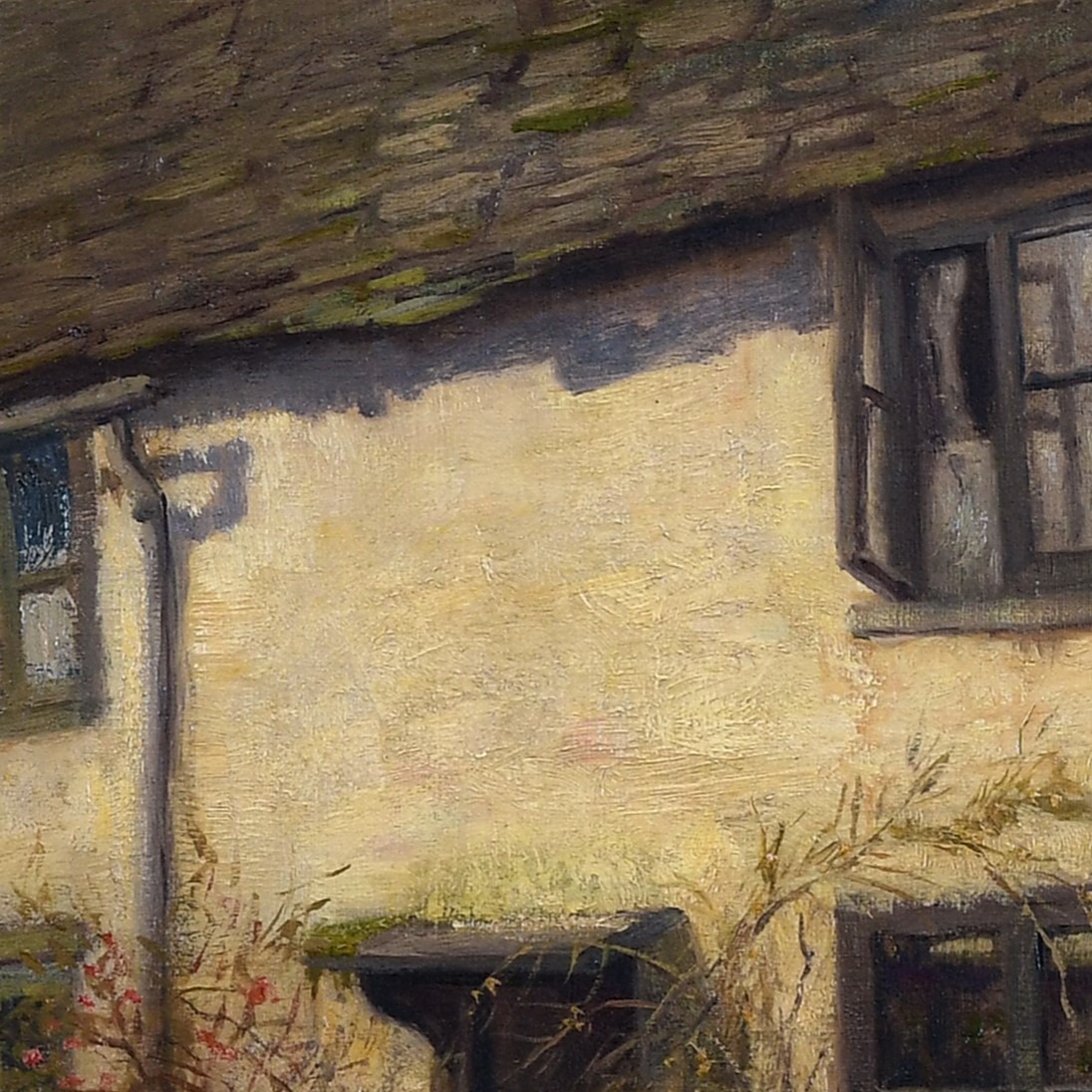
Wellens was influenced by the Impressionists, including Monet, Pissarro and Renoir, as well as the Belgium art movement Luminism of the early 20th century. Their work was characterised by short, loose brushstrokes, unblended colours, and an emphasis on the effects of light. Rather than blacks and whites, shadows and highlights are rendered in colour, as can be seen in the purple shadows and the many coloured spots used to create the cottages and the path.
Like the impressionists Wellens likely painted some of the work outdoors known as ‘en plein air’. This allowed him to capture the effects of light and achieve the effect of spontaneity in the work.


Chippenham Town Council
(opens in a new tab)Official Chippenham Town Council Facebook
Monitored: Mon-Thu: 9am - 5pm, Fri 9am - 4:30pm
Due to the yellow weather warning by the Met Office, and to ensure the comfort and safety of all traders and shoppers, the decision has been made to cancel the market on Friday 23 October.
At present, Saturday’s market will go ahead as planned. We will continue to monitor the forecasted weather and update you again if this changes.

We really do not want people to be choosing their pumpkins in the wind and rain, due to the yellow weather warning issued by the Met Office. To ensure this event can be enjoyed as much as possible, we have made the decision to reschedule the Pumpkin Patch event until Tuesday 27 October at 10am.
If you were hoping to meet the Beauty and the Beast Pantomime Cast, you can still see them in the High Street between 10am - 11am, REEL Cinema Chippenham 11pm - 12pm, Chippenham Library 1pm - 2pm and Chippenham Museum 2pm - 3pm.
The footpath that runs adjacent to John Coles Park, between King Alfred Street and Hungerford Road, remains closed allow essential wall repairs to take place.
Wiltshire Council have advised the works are currently expected to be completed by 31 October 2026, although the closure may be extended if necessary.
A signed diversion route is in place via King Alfred Street, Hardenhuish Avenue, Marshfield Road, Park Terrace and Park Fields.
For further information about the closure or the works, please contact Wiltshire Council on 0300 456 0100 or visit one.network/public